Saturday, 15 February 2014

Return to 中国

So I just returned to Guangzhou after a grand total of 22 days traveling around Southeast Asia for Chinese New Year. It was an incredible time. I visited Hanoi, Moc Chau, and Ho Chi Minh City/Saigon in Vietnam, Vientiane and Vang Vieng in Laos, and Kamphong Cham, Siem Reap, and Phnom Penh in Cambodia. Along the way, I met up and traveling with over half of the current Luce Scholars class, saw some amazing sights, and had plenty of delicious food.

Highlights of the trip include: having a run in with the Lao police after relaxing along the banks of the Mekong River in Vientiane, spending two hours drinking beer and eating snails with four random Vietnamese men (then subsequently adding them on Facebook) on the side of the road in Saigon, having some pre-Tet (the Vietnamese name for Chinese New Year) celebrations with the some friends of my friends in both Hanoi and Moc Chau, boiling all of my clothes, spending a day biking around the temples of the Angkor temple complex, being confronted with the horrors of the Khmer Rouge and the Vietnam War, motoing around the Lao countryside and venturing into a cave, drinking coconuts while having a conversation with a 13-year-old Cambodian girl (whose parents were so proud of her English) who wants to be a doctor when she grows up, drinking absurd amounts of coffee in cafe after cafe in Hanoi...

More details and pictures will follow, but now I really need to go get me some dumplings and peanuts. Because the food in Laos, Vietnam, and Cambodia was absolutely delicious, don't get me wrong, but Chinese food is still superior.

中国(菜)万岁!Long live China (/Chinese food)!

Friday, 24 January 2014

Review to date

Long time no blog. It's almost the Chinese New Year, so happy almost Year of the Horse! I've been busy recently, traveling around with my family and then getting back into work, so have fallen behind. And I'm about to head out again, traveling for three weeks through Southeast Asia during the long vacation that everyone has off.

Recently I had to write a blurb for the Luce Foundation, looking back on my year so far. I figured it's also appropriate for my blog. Here's what I said:


I arrived in Beijing this past summer with a leg up, having studied some Mandarin in college, and so I spent my time improving my listening comprehension and oral Mandarin, as well as focusing on specific vocabulary that would be helpful for my job doing research at the School of Psychology at South China Normal University. Working my way through a paper that my soon-to-be boss had published while struggling to explain its contents to my Mandarin teachers was an incredibly rewarding experience, one that made me even more excited to get back into scientific research in the fall. However, I still had one major concern before heading south, a concern that was revisited every time I discussed my change of location with someone new: after taking a few minutes to tell me how much better Beijing is than Guangzhou, they would always inevitably ask me, “So…how about Cantonese?”

As it turns out, I had no reason to worry. As one of China’s largest and most prosperous cities, Guangzhou’s inhabitants come from all over China, and thus Mandarin is the language of choice across the city. Even in my lab, only three of the twenty or so students speak Cantonese, as the other students are all from outside of Guangzhou. So Cantonese is by no means necessary in this city, yet I still seized upon the opportunity to start taking lessons. I did it for a simple reason – because Cantonese is fascinating. Thanks to Hong Kong, it’s the only non-Mandarin Chinese dialect that can be completely written out, but most Guangzhou speakers cannot write it. It has six, seven, or nine tones, depending on who you ask. It preserves many of the syllable-ending sounds from Middle Chinese that Mandarin has lost, resulting in an often completely different-sounding language. My Chinese friends from outside Guangzhou are just as lost in a Cantonese conversation as I. Yet the question of how to classify Cantonese – as a separate language or a simple dialect – is a hard question to get a clear answer for, even in Guangzhou among scientists researching language and the brain.

While my research at SCNU does not involve Cantonese, it does touch on our capacity to speak multiple languages. In one project, I am investigating how the activation of the brain and the parts involved differ while reading a passage in English and in Chinese and, in the other, I am attempting to reconstruct a computational model used to simulate the language network in the brain, originally trained on Japanese words, and train it on English words instead. Working in an environment where everyone is a Mandarin speaker but almost all of the research is published in English, I read papers in English, listen to lectures in Mandarin, discuss results in a combination of English and Mandarin, help translate or edit papers being written in English, and try to explain, in Mandarin, the difficult parts of a paper written in English by a German researcher working in the USA to a Master’s student from Fujian.

Surrounded by language and constantly spending my time thinking about it, I relish my opportunities to escape into wordless pursuits. Whether it’s painting with my boss’s father, baking treats to share among my friends, throwing my tiles across the mahjong table, wandering around the streets of old Guangzhou, tucking into a hearty bowl of tingzaizhou (a rice porridge filled with all manners of odds-and-ends) at dimsum, or simply relishing a cup (or three) of pu’er tea, these provide a much-needed respite. With these pursuits and the intense intellectual stimulation of my work and study, I am excited to see what the next several months living in the organized chaos that is China’s third largest city will bring.


So that's a brief review of my life in Guangzhou so far. One final note, before I leave for Vietnam: were you aware that Chinese traditional medicine prescribes the consumption of rat/mouse (the two animals have the same name in Chinese) meat to stop bed-wetting? One of my friends was secretly fed rat meat by her mother when she young for this reason. Supposedly it works, so that's good to know. I'm going to be the best at parenting ever.

Saturday, 14 December 2013

Ramblings on Language - Cantonese

It's been a long time since I have blogged, which I apologize for. I've been busy of late, both doing a lot of traveling and with work having picked up, so I haven't really felt like blogging in my spare time.

In the time since I last blogged, I have visited Hong Kong for a weekend, headed to Fuzhou for an International Psycholinguistics of Chinese conference, and headed to Beijing for the better part of a week to visit some friends and celebrate Thanksgiving with a veritable gaggle of Oberlin alums. And I will shortly be heading out on a trip with my family and girlfriend (9 of us in total) on a whirlwind tour through Japan and China. But this blog is not about any of those items.

It is, instead, about languages! Because they're awesome. Especially non-Indo-European languages, because they're completely different from English or the Romance languages that most of us Americans are exposed to.

So I learned Mandarin starting in college, which made moving to China significantly easier. In Guangzhou, however, Mandarin is not the only language around. Guangzhou used to be known in English as Canton and this part of China is the epicenter of Cantonese-speaking in the world. On a day-to-day basis, I don't really run into much Cantonese. I live out of the center of town, near the university, and most of the people living here are not from Guangzhou or even Guangdong (the province of which Guangzhou is the capital). They are 外地人 (wàidìrén), or outside-land-people, people from, well, not here. And nowadays all education in China is conducted in Mandarin, so everyone speaks Mandarin. If I were living in the old city center, there would be many more people who use Cantonese as their day-to-day language, but even they speak Mandarin nowadays. However, a lot of native Cantonese speakers have a very strong accent when they speak Mandarin, which is similar to the accent found elsewhere in Southern China. Specifically, they drop h's from initials (sh-, zh-, and ch- are all pronounced as s-, z-, and c-, the sibilant sounds), interchange the final -n and -ng (sometimes they add a g, sometimes they drop it), and will often pronounce the initial n- as an l-. This made understanding people's Mandarin very difficult at first (the Mandarin you're taught as a foreigner is very standard Mandarin with a slight Beijing accent), though I've gradually gotten better at it.

After moving to Guangzhou, I started to learn Cantonese. It's completely different and, in my opinion, pronouncing the sounds is much harder. There also more tones: either 6, 7, or 9, depending on who you ask. The understanding I've reached is that, technically, there are nine tones, but in modern Cantonese, the 8th and 9th have merged with the 3rd and 6th respectively, and in Hong Kong Cantonese, the 7th has merged with the 1st. So I'm only trying to learn 6 tones, because less is more.

Now the interesting question with Cantonese is whether it's a dialect of Mandarin or a completely different language. And it's kind of a tricky question. In Chinese, Cantonese and other similar languages are all referred to as 方言 (fāngyán) or "place-languages". One attempt at translating this into English is topolect, which I'll use throughout this post. Because neither dialect nor language is entirely appropriate.

Two dialects (like American and British English, or Texas and Cockney if we want to look at even smaller groups) may have different pronunciations, different word usages (bathroom vs. washroom, bloody), different spellings (color vs. colour), and even new grammatical constructions (y'all as the second person plural in Southern American English), but the big thing is that they're mutually intelligible. Every once in a while you may hear a word you don't get, or don't usually hear in that context, but I can pretty much completely understand an English-speaker regardless of where they're in the US or from what Commonwealth nation they're from.

Two different languages, on the other hand, are not mutually intelligible. They may have a lot of overlap in vocabulary (English and French or German) and very similar grammar (all Romance languages), but while you may be able to catch a word here or there, you won't really be able to understand someone speaking another language.

So what makes the Chinese topolects different? It can be kind of hard to say, really. If you were to ask me, while speaking English, I would probably call them all different languages. If we're speaking Chinese, they're definitely 方言. It's partly a political issue, rooted in ethno-nationalism: all languages that the Han Chinese speak are Chinese, because all Han are Chinese. But it's not just an artificial categorization invented by the Communist Party to make people more nationalistic. I had this conversation with a Cantonese friend of mine earlier this week, and the way he phrased it is this: Cantonese and Mandarin are not mutually intelligible, at all, so if you just look at the pronunciation, they're completely different languages. But Cantonese is written using Chinese characters, and when it's written, a Mandarin speaker who knows no Cantonese will understand the text to a pretty good degree. There are some differences (系 instead of 是 for "to be", and 唔 instead of 不 for the negative), but for the most part (and especially for more complicated words), a Mandarin speaker could read a Cantonese text.

That's clearly not true for closely-related languages: I can read French, but a text in Spanish or Portuguese or Italian is complete gibberish as far as I'm concerned. A Mandarin speaker might not understand everything in a Cantonese text, but I can't understand ANYTHING in a Spanish text. So that complicates the classification.

Classification is further complicated by the fact that Cantonese is special among Chinese topolects. No other topolect has a literature and press scene of materials written in that topolect: Cantonese is the only one that is not just a spoken language. And this is because of Hong Kong. All other topolects are just learned by people at home from their parents and are not written. But because Cantonese is, and has been, the dominant language in Hong Kong, there are books written in Cantonese, newspapers written in Cantonese, textbooks produced in Cantonese. So if you spoke Techeow, Shanghainese, Shanxi-ese, or any of the other many Chinese topolects and dialects and I asked you to write out how you would say something in your language, you'd look at me funny and say, "that's impossible." And while most Cantonese-speakers in Guangzhou can't write Cantonese either, Cantonese-speakers in Hong Kong can.

Speaking of Hong Kong, the language environment there is fascinating. Because it's next to Guangdong, most people's native language is Cantonese. Because it was British, there's a large amount of English in the city. Because it's now a part of the People's Republic of China, there's an increasing amount of Mandarin being spoken there. So you have this confluence of Cantonese, Mandarin, and English that is really, really cool.

Mandarin, like French, doesn't really borrow words from other languages. They take foreign words (like email), and China-fy them, making email into 电子邮件(diànzǐyóujiàn), literally "electronic-mail". Hong Kong Cantonese, on the other hand, borrows English words all the time: "sexy", "okay", "cute", "email", and "cheese", are all used in proper Hong Kong Cantonese. A lot of times, Hong Kong native Cantonese speakers will have better spoken English than spoken Mandarin. And, unlike the mainland, people are not that impressed when a foreigner speaks Chinese, either Mandarin or Cantonese.

My favorite interaction involving languages in Hong Kong was while I was walking down the street, looking at the vegetables being sold along the side of the road (because looking at food markets is one of my favorite things to do while traveling), when I saw what looked like a bitter melon. It looked very different from the ones I had seen in Guangzhou though, so I asked the stall owner, in Mandarin, what vegetable it was. She just kind of stared at me, confused, so I asked her, in Cantonese, whether she spoke Mandarin. She said she did, so I asked her again, in Mandarin, what vegetable it was and she responded to me, in Cantonese, that it was a bitter melon from Taiwan (really, it was much uglier than your normal bitter melon). I thought this back and forth of Cantonese and Mandarin was just the coolest thing.

I'm afraid I don't have a good conclusion to the question of how to classify Cantonese, but it's a very interesting point to discuss and think about: it seems to occupy a middle ground between a separate language and a mere regional dialect, but for someone who loves classifying as much as I do, that does not feel completely satisfying.

I apologize for the ramblings on language as opposed to a photo-filled discussion of the cool places I've been, but I'm sure there will be more of those in the future. Though I do have another post about the ties between Vietnamese and Chinese that came out of a conversation with a friend living in Hanoi this year that I'd love to write...

Sunday, 10 November 2013

Cookies!

Today saw the completion of a goal that I've hard for a very long time in China: I successfully baked a batch of chocolate chip cookies. This is more difficult than it initially sounds like and was only possible after overcoming a variety of obstacles.

Firstly, ovens aren't a really a thing in China. While we wouldn't really consider it a full kitchen without an oven in the US, they are not common at all here. In order to get mine, I had to find an appliance store that sold large enough electric ovens. This took a bit of searching (I could have bought it online, theoretically, but the Chinese internet is scary), but I eventually found a place and was prepared to buy my oven, when I was informed they had a sale the following week. Eager to save a bit of money, I waited a week and returned this past weekend only to discover that the oven that I was intending to buy did not qualify anyway. Why the initial salesperson did not clarify this for me is unclear. Regardless, I successfully obtained my oven.

Then, I had to find necessary ingredients. Eggs, flour, white sugar, brown sugar, and (surprisingly) butter, were all easy to find, located in the giant grocery store right next to my apartment. Baking soda, vanilla, chocolate chips, and a baking sheet, however, proved more difficult. Baking soda and vanilla were found at the first foreign grocery store I tried in Guangzhou, which stocks many of the brands you'd expect to see in the US as well as lots of Japanese brands. For a baking sheet, I was, to my confusion, directed towards an electric appliance store, which (to my not-that-great surprise) did not carry any. However, I found cheap aluminum BBQ pans at the second foreign grocery store I checked, and decided those would be good enough.

Chocolate chips, on the other hand, have still proved elusive. Spending the better part of an afternoon checking multiple grocery stores, both Chinese and foreign, across town, turned up nothing. I found cinnamon and butterscotch chips at the last foreign grocery store I walked into, at the whopping price of about $10 per bag. So instead, I picked several chocolate bars from the convenience store in my apartment building, chopped them up, and threw them into the dough. Close enough.

 My equipment is still not quite up to standards. I have no mixing spoon and so relied on my giant pair of cooking chopsticks. And that's not actually a mixing bowl, but a bowl for tossing salad in. Still, it was pretty effective.
And the final product, all packaged up and ready to go. The taste is not quite as I would like it, but I will continue playing around with it. The texture turned out pretty good though, but it took much longer in the oven than I would've guessed. Still, overall a success.

Friday, 8 November 2013

Game of Thrones and Baijiu...

So China really doesn't care about copyright infringement, which is news to absolutely no one. But this commercial takes that disregard to the next level and it is awesome.

It's an add for a Chinese baijiu (the very strong liquor that is quite popular) called Jian Nan, and it is a blatant rip off of the Game of Thrones TV show opening sequence. It's pretty well done too.

Wednesday, 6 November 2013

Tales of Thailand

I just returned earlier this week from Thailand, where I spent a wonderful 10 days enjoying the city of Bangkok and the beaches of Krabi with the other Luce Scholars for our mid-year meeting.

Despite the relatively relaxed nature of the trip (we only had one full day of meetings, as well as a brief check-in interview), I still managed to get not enough sleep and so am still recovering. But here I present several images and thoughts on Thailand.

So Thailand is a monarchy, though a constitutional monarchy. As part of this they have photos of the king and queen everywhere. Every house (even the Luce Scholars who are there) has a photo of the royal family, and you have giant portraits of the king and queen on just about every street. It's a little bit over-the-top, and that's coming from someone who spent the past couple months in China, where propaganda posters (though they're relatively benign nowadays) and Communist slogans are found on every street. But whereas most modern Chinese people think of the propaganda posters as a bit of a joke, the Thai people take the monarchy very seriously. According to my friends who are living there, a lot of people don't believe the king is going to die. He's in his 90s, and every king prior to him as eventually kicked the bucket, so...

I also walked through the Chinatown in Bangkok, because I was walking all around the city and it was marked on my map. They had traditional characters everywhere! It was confusing. Plus there was this cool traditional Chinese gate, covered in Thai script.

The Thai language is also really cool. It has five tones, which I can discriminate (because they're somewhat similar to the four tones of Mandarin, unlike the six tones of Vietnamese or the seven-to-nine tones of Cantonese), and sounds completely different from either Mandarin or Vietnamese. Additionally, the script is just really cool looking. There's not a universally agreed-upon method of transliterating into English letters, so anything Thai written in English doesn't work so well. Basically, I came back from Thailand having made the decision to study Thai at some point in the future. It will happen.
I also saw a lot, and I mean a lot, of temples in Thailand. They were everywhere. This one was right across from the Chinatown gate. They're very different-looking from the temples in China. Lots of pagoda-like shapes, just about always coming to a point like that. And they love gold on their temples.
  
Thailand is also a very Buddhist country, which was a little surprising coming from China, which nowadays is not religious at all. While China has many temples, they're not quite as common as in Thailand and they just about never have monks in them. Every temple I went to in Thailand had at least one monk, and I felt a little bit like I was intruding whenever I walked in and saw them there. They were universally friendly and welcoming however, it was just a little confusing for me.

The top photo of these two is a Thai "spirit house". These are little shrines found across Southeast Asia, on just about every property, in order to appease the protective spirit of a location. Offerings are often left outside them, and apparently it's very common to see businessmen, bustling down the street wearing a suit and tie and carrying a briefcase, stop and bow to the spirit house before continuing on their way to work.


Speaking of Buddhism, I saw a giant Buddha. The Reclining Buddha, located at Wat Pho, in downtown Bangkok, is 140 ft long and 50 ft tall. It is massive, and very impressive. When I showed the first picture to the students I teach, they were really impressed with my photograph skills and demanded to know how I managed to make the Buddha look so big. No folks, it really is that big. And the entire thing is covered in gold, except for bottoms of the feet, which are covered in intricate designs inlaid with mother-of-pearl like the one above.
 Here are some other pictures from Wat Pho, which was just generally a cool looking temple. They love their gold in Thailand, as it ended up on most of the buildings in the temple. Also, those pointy shapes. Definitely a motif in Thai temple architecture.
Also from that same Wat Pho, though this statue just surprised me. It looks very Chinese and I know nothing of its significance. But considering almost nothing else in the temples looked very Chinese, nothing in the architecture or in the style of the statues, this seemed very out of place. There were several similar statues as well, all showing warriors in various poses.
More temples! This temple we just passed by while on a boat getting a canal tour of Bangkok. Bangkok is filled with canals, especially the older parts of the city, and apparently used to be similar to Venice in its reliance on the canals for transport.
This is another temple we stopped at on our canal tour of Bangkok, though we stopped at this one and walked around. Very different looking than the previous ones, in terms of colors, but still with that sloping-to-a-point overall design.
These little guys also looked very Chinese to me. Same temple as the previous few pictures, we see the same guard looking fellow, this time accompanied by a Chinese-looking lion type statue. Don't know what to make of them.
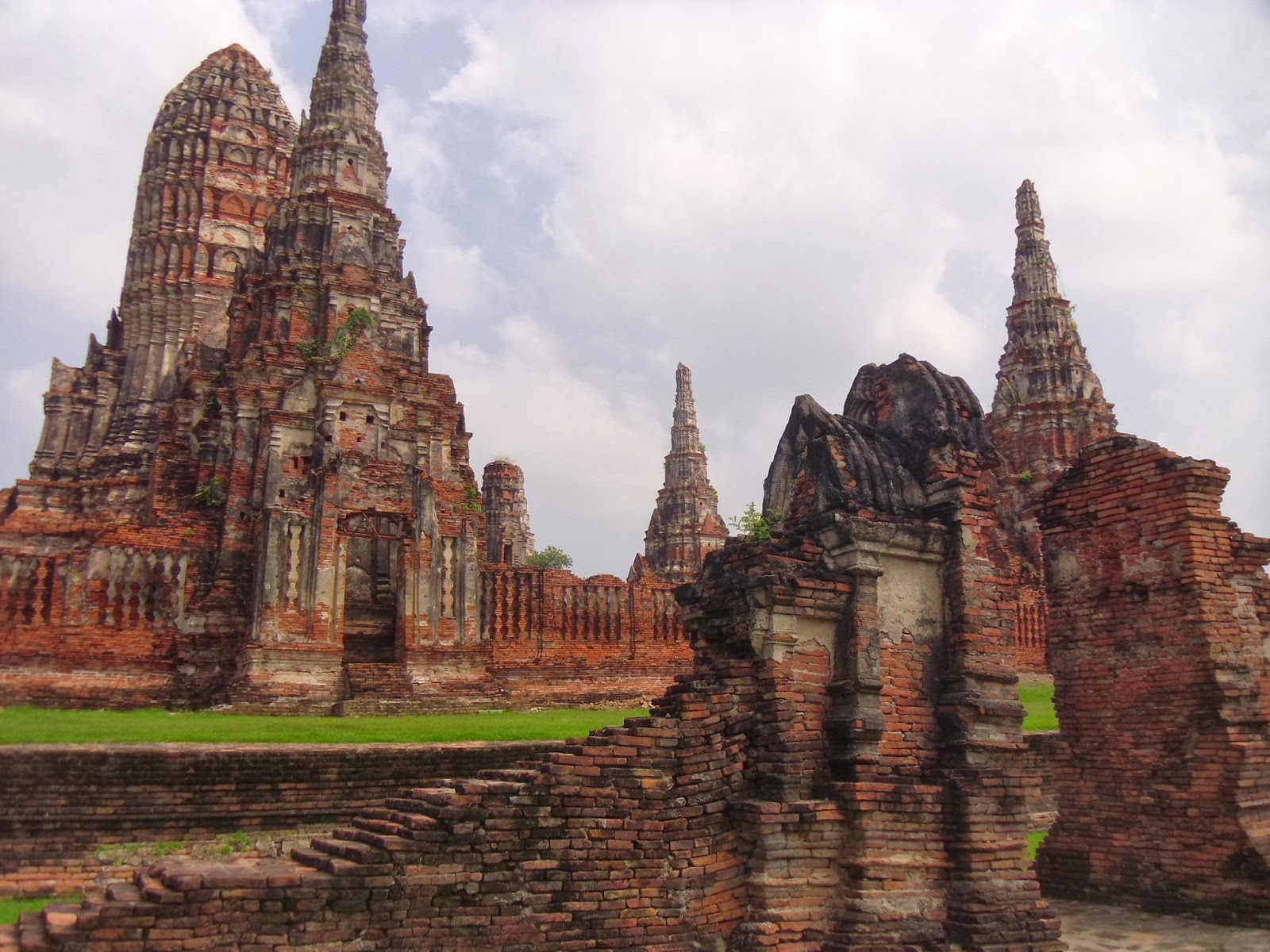
We weren't in the city the whole time though. We took a day to go out to Ayutthaya, the ancient capital of Thailand and about an hour and a half bus ride outside of Bangkok. We walked around some of these ancient temples and then rented bikes and biked through them. Ayutthaya is now a modern, though small city, but every couple of blocks you have a giant temple compound, which was an interesting dichotomy. These temples are all several hundred years old and, despite the sacking of the city by the Burmese during the 1700s, most of them still stand. Again, it's interesting coming from China, where most of the buildings were made out of wood and so burned down on a regular basis. These temples were built to last.

This is a famous site in Ayutthaya, with a sandalwood tree growing around the fallen head of a Buddha statue. Unfortunately, I don't know much more about it.
One thing we noticed is that the majority of the Buddha statues around Ayutthaya, and especially at this temple (this picture and the 3 before it), had been decapitated. I believe it was done by the Burmese when they sacked the place, but it's unclear to me why or whether there's any real significance to it. It could also have been done during the mad rush for Thai artifacts during the 1800 and 1900s, when many statues and temples were taken apart in order to be sold to Europeans and Americans looking to take back a genuine relic.
This statue on the corner of the temple here is actually of Hindu origin, depicting a figure from the great Hindu epic The Ramayana. According to a hasty Wikipedia search undertaken while walking around the temple, the kingdom of Ayutthaya had strong Hindu influences.
This is another temple in Ayutthaya, probably the most interesting of the bunch. We were fortunate that we could walk around; last year when the Luce Scholars visited this temple, the ground was completely flooded, so they could only look at the temple from the parking lot.
More monks!
Some intrepid Luce explorers on their way down from one of the taller points of this temple.
We also went to a Muy Thai boxing match in Bangkok. Very different from the rest of the trip, it was definitely an interesting experience. I've never been to a Western-style boxing match, so I cannot really compare, but it was quite fun to watch. It was fun despite the fact that I had absolutely no idea what the rules were or how the winner was decided. Still, worth seeing.
  
 And I have fewer pictures from the rest of the trip because we spent it in Krabi, a peninsula in Southeastern Thailand, far away from the hustle and bustle of the city. We spent that last weekend relaxing on the beach, surrounded by some absolutely gorgeous rocks.
It was a bit of a trek to get to the beach. We had to fly from Thailand to Krabi airport and then take a van from the airport to the water and finally take a boat across the water to the beach we were staying at. We got a great view of the water on the way to the beach, and everything was just so clear. The air, the water...it was great.
One of the more active days at the beach was spent deep-water soloing, which basically means we free-climbed across rocks until we got tired or decided we were done, and then jumped or fell into the water below. We didn't do it on this rock, but I didn't bring my camera with me so this substitute image will have to do. Now, I can't rock climb at all, and this was my first time, so I only got up about 10 or so feet before jumping or falling into the water. The more impressive members of our cohort, however, climbed up about 50 feet, to the point where there was no more rock for them to climb, before leaping into the water below. I was sitting in the boat, and just watching them climb up there and then prepare themselves to jump had my heart pounding and adrenaline flowing. It was seriously impressive.

And that was Thailand. It was an incredibly fun trip, and is definitely a place I would recommend people visit. I didn't even mention the food, but it suffices to say, it was spicy and it was sour and it was delicious. Anyways, after my 10-day trip to Thailand I realized that I really want to be traveling more, so I immediately planned a weekend trip out to Hong Kong with a friend staying in Hanoi. In about two weeks. Yay! But for now, I have to get work done...

Thursday, 17 October 2013

The Difficulty of Comedy

As I mentioned in a previous post, as part of my responsibilities at South China Normal University I am teaching English to a class of undergraduate psychology majors. In theory, we meet once a week, though in practice this has never been the case due to rescheduling classes around holidays or my travels. I am supposed to grade the students, but I am given no guidelines on how to structure the class: I can teach whatever I want because just the experience of speaking English with me and listening to me speak English will be beneficial for their spoken English abilities.

This has been fairly stressful, but I've sought help from the students by asking what they want to learn about America and what components of the English language they want to focus on. One thing that came up when asking my students this was humor. Humor is notoriously difficult to translate and hard to understand across cultures and even though my students all watch a lot of American TV (honestly, I'm pretty sure almost all of them watch more hours than I do), they often have trouble understanding the jokes contained in them. For reference, the most popular shows that people watch here are "The Big Bang Theory," "2 Broke Girls," "Friends," and "Vampire Diaries."

So anyway, to help explain humor and help my students get a better sense of American contemporary society, I've decided to tell a joke at the beginning of each class, and then explain it, and, additionally, have them watch episodes of "Modern Family" for homework. The Joke of the Day has resulted in me telling such gems as "What did the fish say when it ran into the wall? Dam(n)!" and explaining the classes of "A ___ walks into a bar," and "Why did the chicken cross the road?" jokes. After some explanation, these are generally met with a few appreciative chuckles and nodding from maybe half the students, of which I am fairly proud.

"Modern Family" is harder. I didn't think about it before I had students watch the first episode, but the lack of laugh-track in "Modern Family" makes it very hard for non-American, non-native English speakers to understand what exactly is supposed to be funny. I had the students watch the first episode for class on Monday and email me with at least two jokes, phrases, references, or words that they didn't understand or that they found particularly amusing. Following are some of the responses that I got:

"What makes me puzzled is that when Haley invites her friend to her home, why Claire is so nervous? Americans have the open mind of the relationship of girls and boys, aren’t they?  And are many children mature in America? Manny is just eleven years old but he looks like an adult when he shows his love to the girl?"

"First, what is cream puffs mean when it be used to describe a person. Second, Why did phil mean touch in this TV show."

"Why does Claire say “if Haley never wakes up on a beach in Florida, half-naked,”? Is the beach in Florida special comparing with others? And Why does Phil say “Lily. Isn’t that gonna be hard for her to say?” when Phil know the baby’s name. " 

So in answering these questions, I got to explain: how "cream puff" can be used as a pejorative for gay men, how Americans like to make fun of foreigners' accents, and what a stereotypical college Spring Break is. The second was particularly funny because almost all of my students pronounced Phil and feel the same, just like Gloria's Columbian accent in the show. The part about "Lily, isn't that gonna be hard for her to say?" actually was a little lengthy to explain, because it required explaining: A. That Americans stereotypically lump all Asians together and stereotype them, and B. That the stereotypical Asian English accent can't correctly pronounce "l", and therefore C. The joke is that Phil is assuming that the Vietnamese baby, who is not speaking, will still have an "Asian" accent when she grows up.

In addition to these questions, I also got two categories of students who had trouble coming up with responses for the homework. Either they didn't find the material funny at all and so weren't sure when there were any jokes or they watched several seasons of the show and so couldn't remember things from the first episode or alternatively sent me questions about a random episode from a later season. I was not prepared for either of these possibilities.

And now I am off to bed, for tomorrow I am off to Thailand. The Luce Scholars have a mid-year meeting in Thailand, where we will catch up, meet with the leaders of the program (the wonderful Li Ling and David Kim), and discuss how our placement has been so far. We will also enjoy being in Thailand and wander around Bangkok and lounge on the beautiful beaches of Krabi. It's a rough life.